Blog · Editing
How much does a video editor cost in 2026?
By Tomás Castaño · November 10, 2026 · 9 min read
One 2026 rate guide puts a 10 to 20 minute YouTube edit between $100 and $2,500 per video, depending on the editor's level and the complexity. Another puts a short between $15 and $150. Freelance hourly rates run from $25 to $150. The number that matters is what is inside the edit: how much raw footage there is, how many graphics it needs, how many rounds of changes, and who decides what stays.
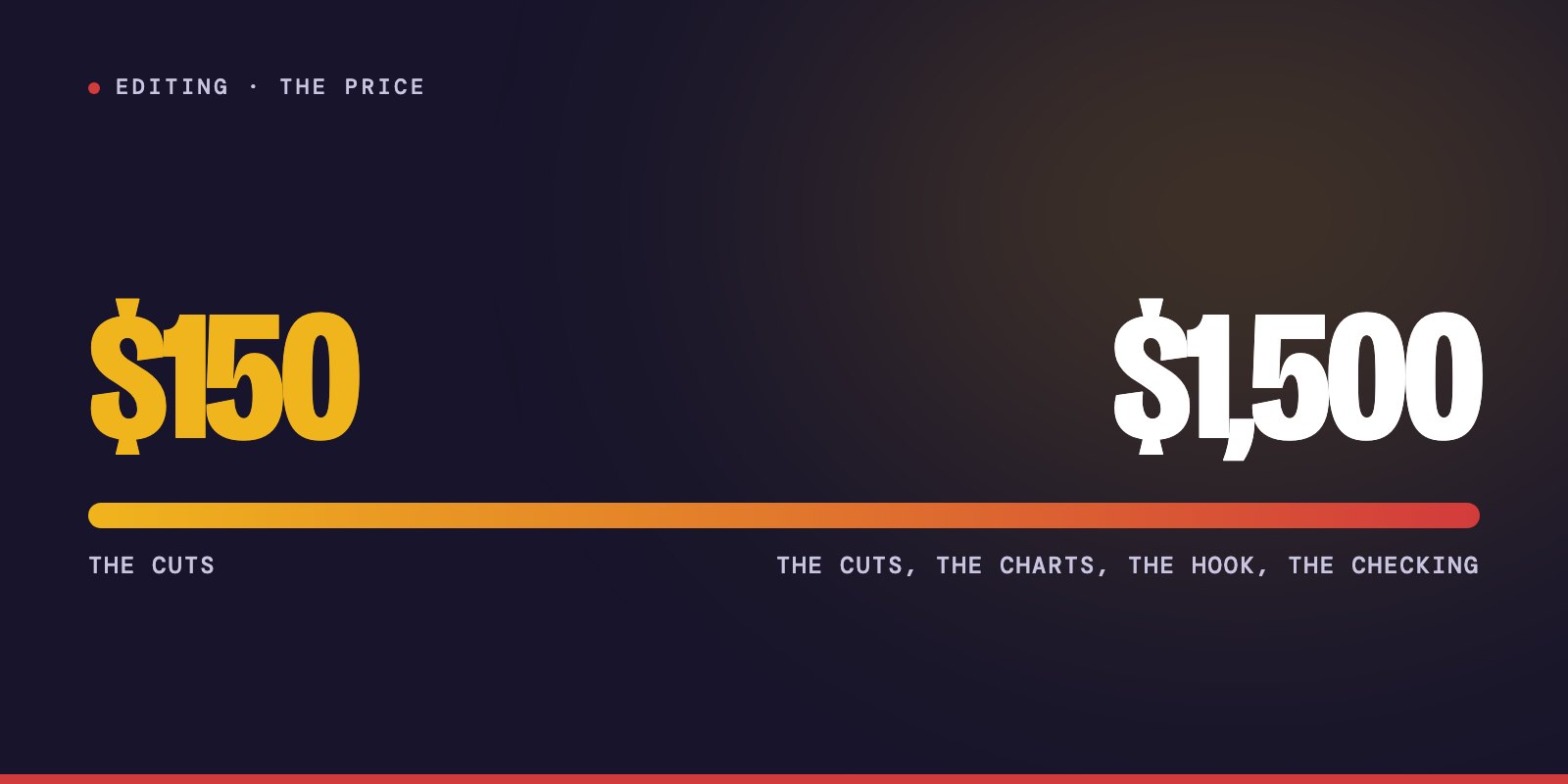
Two editors can look at the same ten minute video and quote $150 and $1,500, and neither of them is lying. One is pricing the cuts. The other is pricing the charts, the hook, the checking and the decisions.
That is why nobody can answer this question with a single number. So I will give you the numbers first, and then the part the price lists leave out.
How much does a video editor charge per video?
I read the rate guides that agencies and marketplaces published this year. They do not agree with each other, which already tells you something, but the ranges overlap enough to be useful:
- A long-form YouTube video of 10 to 20 minutes: one 2026 guide gives $150 to $300 from a beginner, $300 to $800 from an intermediate editor and $800 to $2,500 from a senior editor handling complex builds. Another says a quality 10-minute edit on freelance marketplaces typically runs $150 to $350.
- A short for Reels, Shorts or TikTok: $15 to $150 each, according to one breakdown, which adds that most growing channels pay $40 to $120.
- Motion graphics and animation are the expensive end. The same guide says they can double or triple a per-video rate.
Those figures come from companies that sell editing, so treat them as a map of the market and not as a law.
How much does a video editor charge per hour?
The same guide puts freelancers between $25 and $150 an hour, from beginner to senior, and agencies between $100 and $250.
I would be careful with hourly pricing, though. An hour is a strange unit for this job. A fast editor who knows your channel finishes much sooner than a new one, and by the hour the slow one costs you more. If you pay by the hour, you are paying for time. If you pay by the video, you are paying for a result. Most channels are better served by the second.
How much does it cost to hire a video editor for YouTube every month?
Once you publish every week, per-video pricing stops making sense and you move to a monthly arrangement. One guide says intermediate YouTube editors charge $1,700 to $3,500 a month for roughly four long-form videos plus social cutdowns. At the cheap end, one subscription service's basic plan covers up to seven videos for $800, about $114 each, and a full-time offshore editor is quoted at about $1,600 a month. Those three prices do not buy the same thing, so ask what each one includes.
A full-time editor on your team costs more than any of that. For a reference that is not a sales page: the U.S. Bureau of Labor Statistics reports that the median annual wage for film and video editors was $70,980 in May 2024, with the lowest tenth earning under $39,170 and the highest tenth over $145,900. That is the United States, and salaries in other countries are different. What a full-time editor gives you is something a marketplace cannot: a person who has watched every video you ever published and knows what your audience forgives and what it does not.
How much does a video editor cost outside the U.S.?
Less, and a large part of the reason is the cost of living. I should say first that I am an interested party: I work from Colombia.
The clearest comparison I found is a 2026 salary report by Talent Scout, a recruiter that places Latin American professionals with U.S. companies. It lists what editors with five or more years of experience earn in four countries, next to the United States:
- United States: about $7,842 a month in base salary.
- Mexico: $1,850 to $2,350 a month.
- Brazil: $1,900 to $2,400.
- Colombia: $1,700 to $2,150.
- Argentina: $1,500 to $2,650.
Those are salaries, not what you pay if you hire through an agency. The same report says its own all-in price for a placed senior hire is $3,500 to $4,500 a month. And the report comes from a company that earns money when you hire in Latin America, so read it with that in mind.
For the Philippines, the least interested source I found is Indeed. Based on 519 job postings, it puts the average video editor salary at ₱25,899 a month, with a typical range of ₱14,813 to ₱45,281. At about 63 pesos to the dollar, that is roughly $410 a month, and $235 to $720 for the range. Those are postings inside the Philippines. Editors who work for foreign clients usually charge more: one guide puts editors in South and Southeast Asia at $15 to $30 an hour on the open freelance market.
The price is the easy part to compare. Before hiring abroad I would check three things:
- The hours you share. An editor in Bogotá or Mexico City works during the U.S. day. An editor in Manila is twelve or more hours ahead of New York, which suits overnight turnarounds and makes a live call harder.
- The English. Your editor has to hear when a sentence is finished, catch a wrong word in a caption and understand a joke. That matters more in an interview than in a montage.
- Who checks the work. A lower price does not remove the review. Somebody still compares every number on screen with what was said.
What actually changes the price
Here is the part I can speak about from the chair. In my experience the price is decided by four things, and video length is not one of them.
The raw footage. A ten-minute video cut from fifteen minutes of footage and the same ten minutes cut from three hours are two different jobs, because somebody has to watch the three hours. One production company puts the range at two to ten hours of editing for each finished minute, depending on how the video was shot. When you ask for a quote, say how much you recorded, not how long the final video should be.
The graphics. This is the big one. A talking head with clean cuts is one job. A talking head where every number gets a chart, every news story gets its headline and every place gets a map is another job entirely. Every one of those graphics is a small project of its own. That is where the hours go, and that is what separates a $150 edit from a $1,500 one.
The rounds of changes. One round of notes is normal. Four rounds means the brief was unclear, and somebody pays for that. A good editor asks the uncomfortable questions before starting, so the first version is already close.
Who makes the decisions. If you hand over a script, a shot list and timestamps, you are hiring hands. If you hand over two hours and "make it good," you are hiring judgment: someone who finds the story, chooses the hook and decides what the viewer never needs to see. Judgment costs more, and it is the part you cannot buy by the hour.
Freelancer, agency or full-time editor?
I have worked inside an agency and inside a creator's own team, so here is how I would choose.
- A freelancer fits when you publish once or twice a month, or when you are still finding the style of the channel. You pay per video and you manage the relationship yourself.
- An agency fits when you need volume and several formats at once: the full episode, the clips, the shorts, the ads. You pay more, and you get a team with a process and somebody whose job is to deliver on Friday.
- A full-time editor fits when the channel is the business. For six years I was part of the team behind two finance channels that grew from zero to more than 700,000 subscribers. That kind of growth is slow and cumulative. It came from the same people making a thousand videos together and learning from each one.
How to tell if a quote is fair
A quote is fair when you can see what is inside it. Before paying anyone, I would ask:
- How many minutes of raw footage does this price cover?
- How many graphics are included, and what counts as one?
- How many rounds of changes?
- Does it include the thumbnail, the captions, the vertical clips?
- When do I get the first version?
An editor who answers those five without hesitating has done this before. An editor who answers "it depends" to all of them has not thought about your video yet.
Is a cheap editor a bad idea?
Not always. If your video is a screen recording with a few cuts, a beginner at the low end of that range is the right hire and paying more would be waste.
And yet most channels that stall are not stalling because of the cuts. They stall because nobody is deciding. Nobody chose the first thirty seconds. Nobody noticed that the best line of the interview is at minute forty-one. Nobody checked whether the chart on screen matches what the guest said. A cheap edit gives you a shorter video. It does not give you a better one.
What AI changed about the price, and what it did not
I edit with AI every day. It transcribes, it finds the repeated takes, it builds the first assembly inside Premiere. So the fair question is how much time that saves, and the published numbers do not agree with each other.
Surveys from this year go from less than an hour saved a week to seventeen, depending on who asked and who answered. I compare them in how long it takes to edit a YouTube video.
So be careful with any editor, or any tool, that promises you a fixed discount because of AI. The saving depends on the video. What did not go down is the checking. Every figure an AI puts on screen has to be compared with what the person actually said, and that is still a human reading a transcript against a chart. If an editor tells you AI made the work cheap, ask who reviews it. I explain what AI does and does not do in an edit in another article.
So, what should you budget?
Start from the video you want and not from the price you hope for. By those guides, a clean weekly interview with light graphics sits in the low hundreds per episode. The same interview with charts, headlines, a designed hook and a batch of shorts sits several times higher, and it is a different product.
You are not paying for minutes of video. You are paying for the decisions inside them.