Blog · Storytelling
How to make a good YouTube hook
By Tomás Castaño · November 10, 2026 · 8 min read
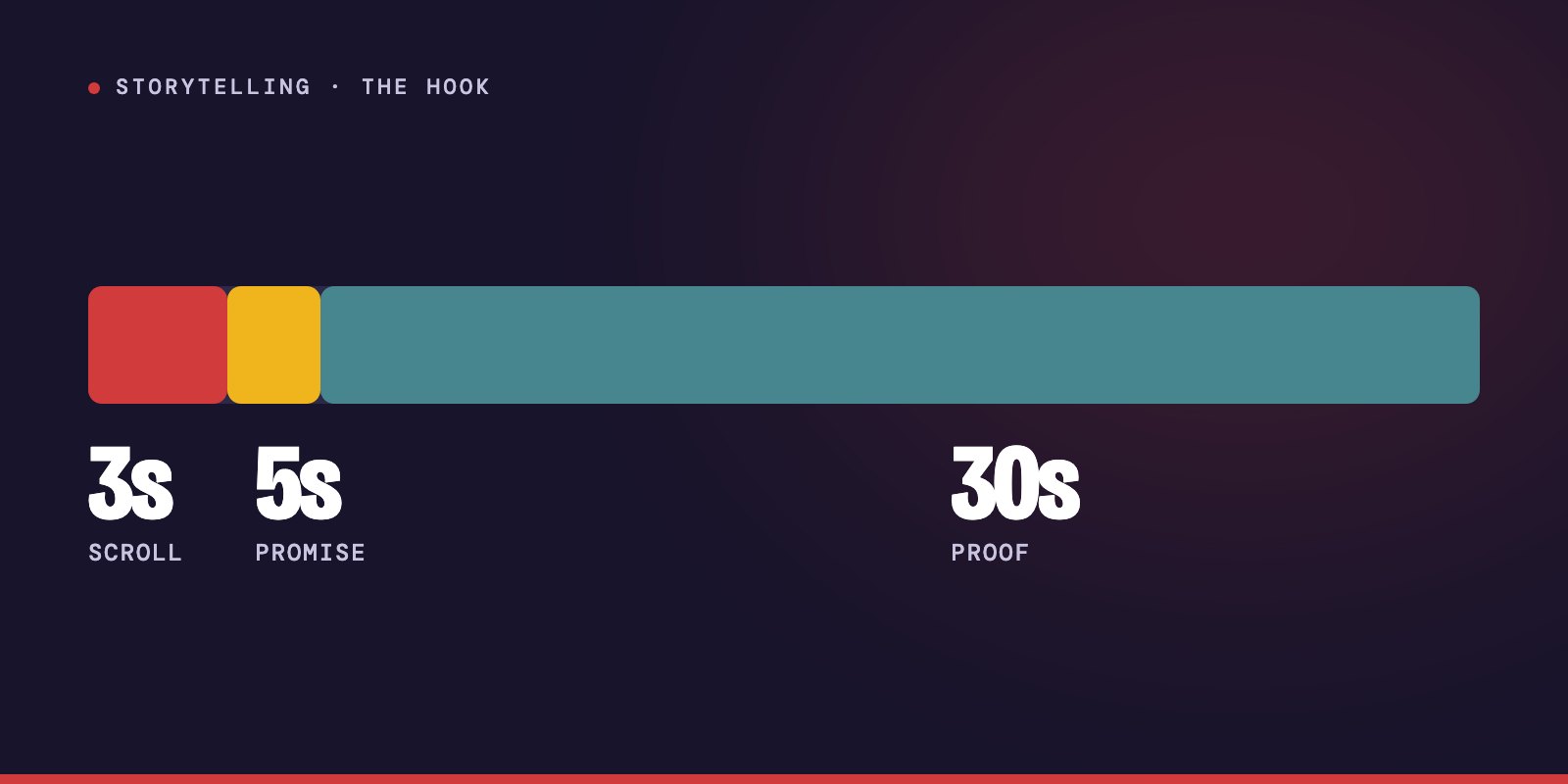
A good YouTube hook is twenty to thirty seconds that prove the title was true. Build it after the video is finished, take the strongest moment from the second half, and give each part a job: three seconds to stop the scroll, five to make a promise, thirty to show the video is worth staying for.
Most recordings begin the same way. The host says hello, thanks the sponsor and introduces the guest. It is polite, it is in order, and it is the worst possible opening for a video, because nothing has happened yet.
The hook is not the beginning of the conversation. It is the reason to watch it. Those two are rarely in the same place.
What is a hook in a YouTube video?
The hook is the opening of the video, the part that plays before the viewer has decided to stay. On YouTube that decision happens fast, and the platform measures it. YouTube Studio reports a figure it calls "Intro": the share of viewers still watching after the first 30 seconds.
A hook has one job. Somebody clicked because the title and the thumbnail promised something. The hook has to prove, quickly, that the promise was real.
Why a hook works: the gap
There is research behind this, and it helps to know it.
In 1994 the psychologist George Loewenstein published a review in the journal Psychological Bulletin called The Psychology of Curiosity. His argument was that curiosity is what we feel when we notice a gap between what we know and what we want to know, and that the feeling gets stronger as the gap gets smaller. Total ignorance does not make us curious. Knowing most of something, and missing the last piece, does.
That is exactly what a good hook builds. It tells the viewer enough to care and holds back the one thing they now need. A hook that explains everything closes the gap. A hook that explains nothing never opens it.
Alfred Hitchcock described the same thing from the director's chair, in his 1962 conversations with François Truffaut. Let a bomb go off without warning and the audience has fifteen seconds of surprise. Show them the bomb under the table first, and they will sit through fifteen minutes of ordinary conversation without looking away.
How long should a YouTube hook be?
Twenty to thirty seconds for a long video. YouTube itself measures this window: in its analytics, the figure called "Intro" is the share of viewers still watching after the first 30 seconds. I think about those thirty seconds in three marks:
- Three seconds to stop the scroll. A face mid-sentence, a number, a movement. Something that is already happening.
- Five seconds to make a promise. By now the viewer should know what this video will give them.
- Thirty seconds to prove it is worth staying for. A first taste of the payoff, so the promise does not sound empty.
Those three numbers are not mine. Each one comes from how the platforms themselves count attention.
Three seconds is the mark the short-video platforms use. TikTok's own creative guidelines for advertisers say to introduce what the video is about in the first 3 seconds and to put the hook in the first 6. Meta reports a video play once it reaches three seconds.
Five seconds is the mark YouTube uses for ads. On a skippable ad, the skip button appears after 5 seconds. YouTube decided that five seconds is how long a video gets before the viewer is handed the exit. I treat every video as if that button were there.
Thirty seconds is the mark YouTube uses for your own videos. The "Intro" figure in YouTube Studio is the percentage of viewers still watching at second thirty.
What I could not find is a reliable study that says how many viewers leave at second three or second five on YouTube. Plenty of blogs quote percentages. None of the ones I checked showed where the number came from, so I am not repeating them here. The marks are real. The drop-off figures you see quoted are mostly guesses.
After thirty seconds, the title card comes in and the video begins.
Build the hook last
This is the advice I give most often. You cannot choose the best moment of a video you have not finished.
So I edit the whole thing first: clean the dialogue, set the chapters, add the graphics. Only when the full cut exists do I go back to the start and ask what the strongest thing in it is.
Writing the hook first is how you end up with an opening that promises one video and delivers another.
Take the hook from the second half
A long interview has peaks. I look for the one people are already searching for right now, and I prefer a peak from the second half.
There is a reason. If the hook shows a moment from minute forty, the viewer who wants that moment stays through the interview to reach it. The promise at the start is paid late, and the wait is the retention.
Promise it early. Pay it late.
How to make a good YouTube hook, step by step
This is the process I follow.
- Find the peak. Read the transcript of the finished video and mark the lines where something is revealed, admitted or contradicted.
- Check it against search. Of those lines, which one answers a question people are typing today? That is the one.
- Cut it to twenty or thirty seconds. Remove everything the line does not need. A hook tolerates no warm-up.
- Dress it. Music from the first frame, sound on the cuts, the key words on screen, and the headline or the chart if a fact is mentioned.
- Hand over to the title card. The hook ends, the title appears, and the video starts from the beginning with the viewer already invested.
YouTube hook examples from real videos
Four hooks I cut recently, each solving a different problem.
The guest speaks first. In an interview about global debt, I opened on the guest, not the host. He says the line, and the camera follows the debt curve up the chart while each word lands. The viewer hears the thesis from the person who holds it.
The headline montage. A host reads the week's news at full speed. I put every real headline on screen exactly on its word, timed to the audio. It turns a list into a rhythm.
The footage carries it. For a travel vlog there was no thesis to state, so the hook is the place itself: the beach, the people, one number on screen, then the title.
A sentence that needs an ending. A vlog opens with "Flew out here to get a deal done," and then: the man in the next seat had a 75 billion dollar hedge fund. You stay to find out what happened in that seat.
Four different techniques. All of them do the same thing: they open a question the video will close.
How to make a good hook for a YouTube Short
A short has no thirty seconds to spend. The hook is the first sentence, and often the first three words.
Start in the middle of the idea. Cut the greeting, the context and the "so." If the short comes from a long video, the line that works is usually the conclusion, said first, and then the explanation. On a long video you promise early and pay late. On a short you pay immediately and explain after.
The mistakes that kill a hook
These come from my own edits and from watching other people's, not from a study:
- The logo animation. Five seconds of branding before anything happens. The viewer is gone by the fourth.
- The greeting. "Hey everyone, welcome back to the channel." Nobody clicked for that.
- The summary. A hook that explains everything leaves no reason to watch.
- The lie. A hook that shows a moment the video does not contain. It wins the click and loses the viewer, and the next video pays for it.
- The mismatch. The title promises one thing and the opening talks about another. The viewer assumes they clicked the wrong video.
How do you know if your hook worked?
Open the retention graph in YouTube Studio and look at the first thirty seconds.
YouTube's own help says a gradual decline is normal. What you are looking for is the shape, and here I am reading from experience: A cliff in the first five seconds means the opening did not match the title. A slow slide between ten and thirty means the promise was clear and the proof was weak. A line that flattens after the title card means the hook did its job.
Then change one thing in the next video, and only one. If you change the music, the first line and the length at the same time, you will never know which one mattered.
Does the hook need music and sound effects?
It needs them more than any other part of the video, and it needs them to mean something.
Music from the first frame tells the viewer what kind of video this is before a word is understood. A sound on a cut makes the cut feel intended. A low hit under a number makes the number land. I add each of those when it supports a word that matters, and I leave the rest quiet, because a hook where everything is emphasized has no emphasis at all.
What a hook really is
For a long time I thought of the hook as a trick to keep people from leaving. I do not think that anymore.
A hook is a promise the editor makes on behalf of the video. It says: this is in here, and it is worth your time. If the video keeps the promise, the viewer comes back for the next one. If it does not, no opening will save you twice.
The hook earns the first thirty seconds. The video has to earn the rest.