Blog · Storytelling
How to repurpose podcast content: one recording, 24 pieces
By Tomás Castaño · November 10, 2026 · 6 min read
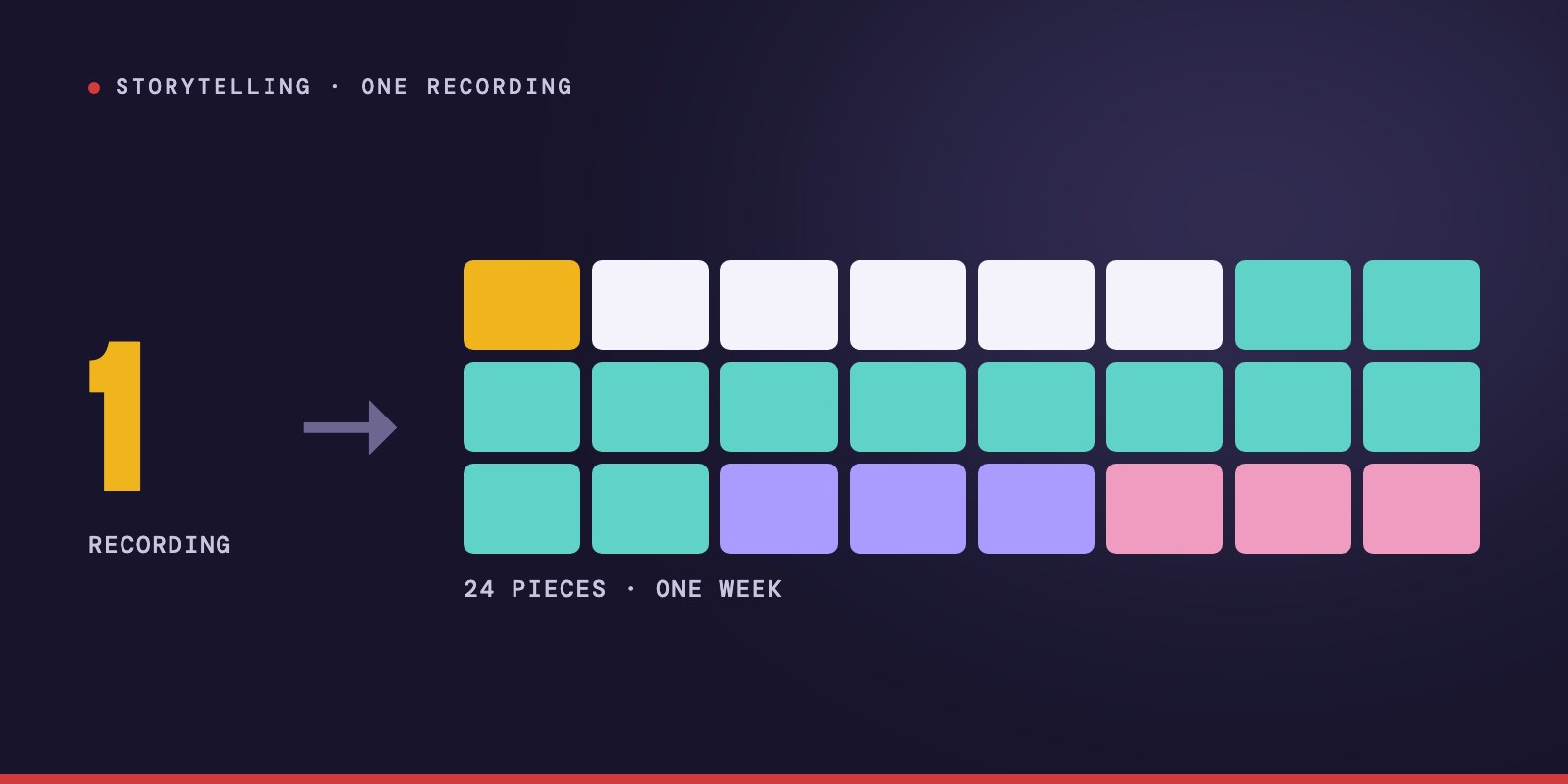
To repurpose a podcast, edit the full episode first and cut everything else from it. One recording can become 24 pieces: the full episode, five mid-form cuts, twelve vertical shorts, three carousels and three articles. That is three or four pieces a day for a week, from a single recording session.
A podcast host records for an hour, publishes the hour, and starts thinking about next week's guest. I see it constantly. The best line of the conversation is at minute forty-one, and the only people who will ever hear it are the ones who were still listening at minute forty-one.
That is the problem repurposing solves. The conversation already happened. Most of its value is still sitting in the recording.
What does it mean to repurpose podcast content?
It means making several pieces from one recording, each one built for the place where it will be published.
The word that matters there is built. Repurposing is not chopping the hour into random minutes and posting them everywhere. A vertical short, a ten-minute cut on YouTube, a carousel and an article are four different ways of reading, and each one needs the idea to be shaped for it.
Where the idea comes from
I did not invent it. The best-known version is the content model Gary Vaynerchuk describes on his own site: record one long piece of "pillar" content, such as a keynote or a show, then cut it into smaller pieces for each platform. He writes that his team turned a single keynote into more than 30 pieces.
The principle is sound, and the number is the least important part of it. What I would add, after doing this every week, is that quantity is easy and fit is hard. Thirty pieces that all feel like leftovers teach an audience to scroll past you. Fewer pieces, each one made for its place, do the opposite.
What can one podcast episode become?
This is what I deliver from a single recording, within a week:
- One full episode. Cleaned, divided into chapters, with graphics and a hook.
- Five mid-form cuts. Each one short enough to watch in a sitting, with its own argument and its own title.
- Twelve vertical shorts. Captioned word by word for Reels, Shorts and TikTok.
- Three carousels. The ideas that never fit in a clip, told slide by slide.
- Three articles. So the episode keeps showing up on Google long after the week is over.
That is 24 pieces. The numbers shift with the episode, since a dense conversation gives more and a thin one gives less, but the proportions hold.
How to repurpose a podcast, in order
The order matters more than the tools. Done in the wrong order, you watch the raw footage five times. Done in the right order, you watch it once.
First, the full episode. Clean the dialogue, set the chapters, build the graphics, choose the hook. Everything else will be cut from this finished version, never from the raw recording.
Then, the mid-form cuts. Each chapter of the episode is already a candidate. I look for the ones that stand alone: a question, an argument and an answer, with no need for what came before. Each gets its own title, written as the question it answers.
Then, the shorts. Now I am looking for sentences, not chapters. A claim that surprises. A number. A line someone would repeat to a friend. Each short holds one idea and nothing else.
Then, the carousels. Some ideas are too structured for a clip: a list of four causes, a comparison, a sequence of steps. Those do not work spoken in forty seconds. They work beautifully in eight slides, where the reader sets the pace.
Last, the articles. I take the three strongest questions the episode answered and write each one as a piece people can find on Google. Not a transcript. An article that stands on its own and points back to the episode.
Why the full episode comes first
Because the graphics get built once.
When I make the chart for the full episode, the same chart goes into the mid-form cut that covers that topic, gets rebuilt for the vertical frame of the short, and becomes a slide in the carousel. If I had started with the shorts, I would have built that chart four times, slightly different each time.
The same goes for the decisions. Which take of that sentence is the good one, how the guest's name is spelled, which music belongs to this show. Decide it once, in the long version, and every other piece inherits it.
A week of publishing from one recording
Here is how 24 pieces spread across seven days, three or four a day, with nothing posted twice:
- Monday: the full episode and two shorts.
- Tuesday: a mid-form cut, a short and an article.
- Wednesday: a mid-form cut, two shorts and a carousel.
- Thursday: a mid-form cut, a short and an article.
- Friday: a mid-form cut, two shorts and a carousel.
- Saturday: a mid-form cut, a short and an article.
- Sunday: three shorts and a carousel.
You record once a week, and every platform has something new from you every day. The host's work is the conversation. Everything after that is editing.
How to turn a podcast into shorts that people actually watch
Most podcast clips fail for the same reason: they need context the viewer does not have.
A good short works for someone who has never heard of the show. So I test each one with a simple question: if this were the only thing a person saw from this episode, would it make sense? If the answer needs "well, before this he was saying," the clip is not ready.
Three things fix most of them, and I cover them fully in how to make Shorts from a long video. Start on the conclusion and explain after. Put the captions on screen word by word, because a lot of viewing happens with the sound off. And rebuild the graphics for the vertical frame, since a chart designed for a wide screen is unreadable when it is squeezed.
How to turn a podcast into articles for SEO
An episode leaves the feed quickly. An article can keep being found through search after that.
The mistake is publishing the transcript. A transcript is how people talk: circular, interrupted, full of "you know." Nobody searches for that, and Google does not rank it.
What works is to find the question the episode answered and write the answer properly. The title is the question, phrased the way a person types it. The first paragraph answers it. The rest develops it, with the guest's best lines quoted exactly. Then a link to the full episode for whoever wants the whole conversation.
I do this on my own site: 81 articles in its first ten weeks, each one built on a question people were already typing.
Why one person should make all of it
You can give the episode to one editor, the shorts to another, the carousels to a designer and the articles to a writer. Many shows do.
The cost is the voice. Four people hear four different shows. The clips emphasize one thing, the article another, the carousel a third, and the audience meets a slightly different host on every platform.
When one person makes all of it, the same judgment runs through every piece. The line I chose for the hook is the line that opens the short and the sentence that titles the article. Every piece points to the others.
What to do before you press record
Repurposing gets easier if you plan for it:
- Decide the three questions this episode will answer. Those are your articles and your mid-form titles.
- Mark the moments. When the guest says something sharp, note the time. That is a short.
- Ask for the list. When the guest has a framework, ask them to go through it point by point. That is a carousel.
- Record video. Audio alone cuts your options in half.
You already did the hard part, which is the conversation. Publishing only the hour is like writing a book and printing a single copy.
Record once. Let every platform have the piece that was made for it.