Blog · Editing
What does a video editor actually do?
By Tomás Castaño · November 10, 2026 · 6 min read
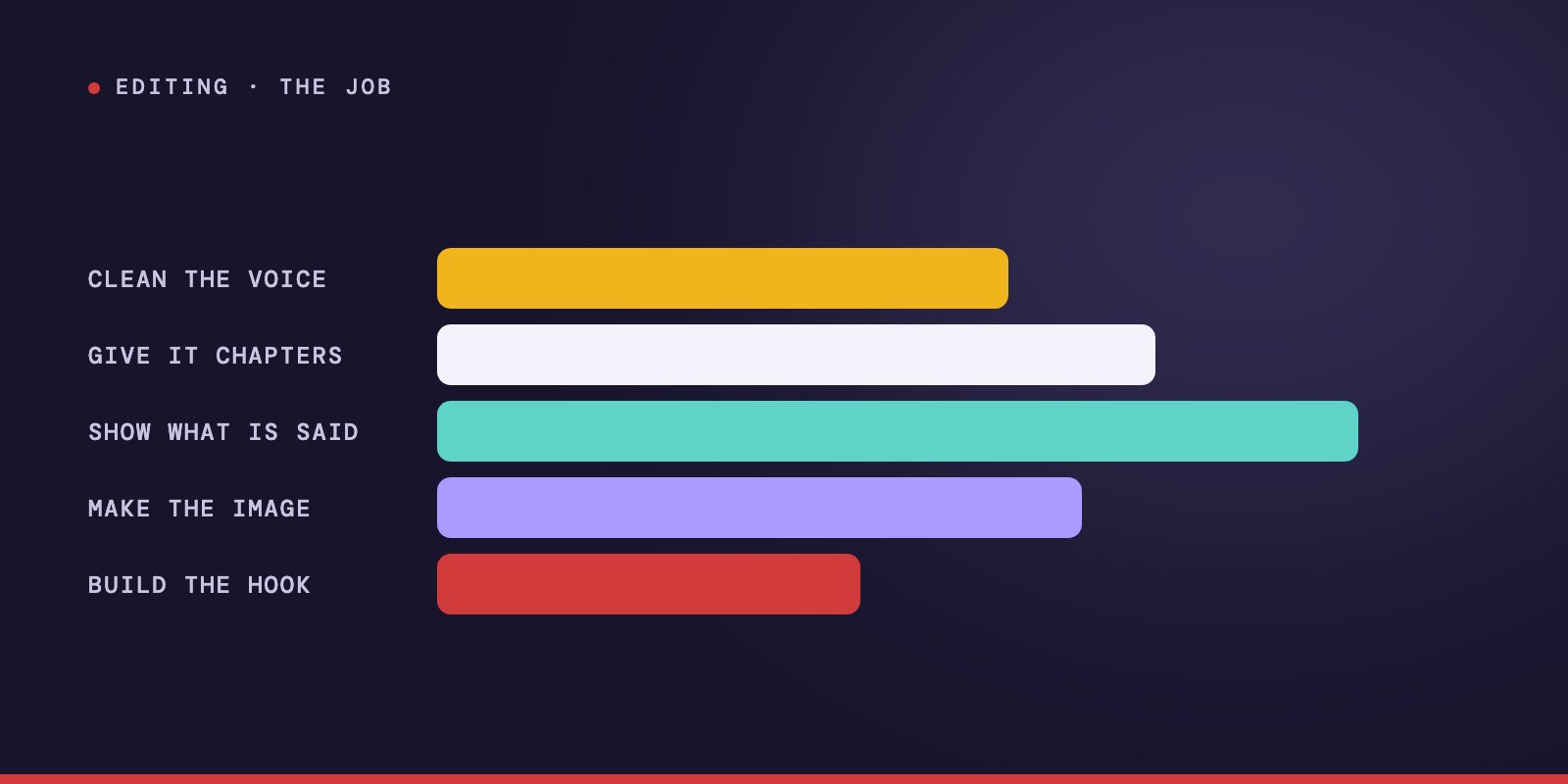
A video editor decides what the viewer sees, hears and never has to sit through. The job has five parts: clean the dialogue, give the video a structure, show what is being said, fill the gaps where there is no footage, and build the first thirty seconds. Cutting is the smallest part of it.
When I tell someone I am a video editor, they usually picture a person removing the bad parts. I understand the picture. From the outside, that is what a finished video looks like: the same conversation, only shorter.
And yet if removing were the job, the software would have replaced me years ago. It already removes silences better than I do. What it cannot do is decide. So let me walk you through what happens between the moment I receive two hours of footage and the moment you watch twenty minutes of it.
What does a video editor do all day?
I listen. That is most of the first day, and it surprises people.
Before I touch an image, I listen to how the person talks. Where they hesitate. Where they repeat themselves. Where they say "um" right before the sentence that matters. A long interview has a shape, and I cannot cut it until I know where the shape is.
Then the work goes in an order. I have done it in this order for years, because each step depends on the one before.
Step one: clean the voice
Silences, filler words, throat clears, false starts, the question the host asked twice. All of that comes out first.
It sounds like housekeeping. It is the foundation. Once the conversation has its own rhythm, every later decision has something to answer to. If I add graphics to a conversation that still drags, I have decorated a problem.
Step two: give it chapters
An hour is a long time to ask of anyone. So I divide it.
Each chapter opens with a title card and a new piece of music. It is a small thing, and it changes how the hour feels: the viewer senses the video moving forward and stops checking how much is left. A good structure makes time pass without being noticed.
Step three: if they say it, show it
Some subjects are hard to follow by ear: debt, interest rates, the dollar. A sentence can be true and still slide past the listener.
So whatever the speaker mentions, the viewer gets to see. Nothing important is said without being shown. It is the second of the four rules I edit by.
This is also where most of the hours go. In one month I built 762 graphics. Nobody watching counts them. They only notice that the video was easy to understand.
Step four: when there is no footage, make the image
Sometimes the story exists and the pictures do not. Somebody describes a day that nobody filmed.
An editor has to solve that, and there is more than one way: a comic, a drawn character, an animation, scenes generated from a storyboard. The technique changes with the person telling the story. The job is the same: the viewer should never stare at a face for three minutes while something interesting is being described.
Step five: the first thirty seconds
I build the opening last, when the whole video already exists.
The opening is made from the rest of the video, so it cannot come first. Once the full cut exists, I go back to the start and decide what the viewer sees before anything else. Those seconds get more work than any other part, and I go through it in detail in how to make a good YouTube hook.
The experiment that explains the job
This is not only my opinion. About a century ago the Soviet filmmaker Lev Kuleshov showed it in an experiment film schools still teach. He put the same shot of an actor's blank face beside a bowl of soup and then beside a coffin. Audiences saw hunger in the first and grief in the second. The actor had done nothing. The meaning was made by the edit.
So when people say an editor "puts the clips together," they are describing the part a machine can do. The part Kuleshov was showing is the choosing.
What makes a video editor good?
I have trained other editors, and the difference between a good one and a fast one comes down to a few things.
- A good editor cuts on meaning. The cut comes when the idea changes, not when a timer says so. I explain why in what retention editing is.
- A good editor checks the facts. If the chart on screen shows a figure the guest never said, the video is wrong, no matter how beautiful the chart is.
- A good editor is invisible. Nobody should notice a cut. They should only feel that the image arrived when they needed it.
- A good editor knows the audience. After a thousand videos for the same channel, you know what that audience forgives and what makes it leave.
Is a video editor the same as a content creator?
No, although the line is thinner than it used to be.
A content creator decides what the video is about and puts a face on it. An editor decides how it is told. On a small team one person often does both, and I do: I run my own account, where I write, film, edit and publish everything. That is where I test ideas before they reach a client.
The same goes for the motion designer, who builds the graphics, and the videographer, who records. On a large production those are three people. On YouTube, more and more, they are one editor who learned the other two jobs.
What does a video editor's portfolio look like?
If you are hiring, this is how I would read one.
Do not look for the flashiest ten seconds. Look for a long video and watch three minutes from the middle, where nobody was trying to impress you. Is it easy to follow? Do the images arrive when the words need them? Then look for range: an interview, an ad, a vertical clip. And look for numbers the editor can explain, such as how many videos they delivered and for how long they kept the same client. An editor who stayed six years with one channel learned things a showreel cannot show.
What a video editor does not do
It helps to be clear about this before hiring one.
An editor cannot fix a conversation that had nothing in it. I can make a good interview shorter, clearer and more watchable. I cannot make a guest say something interesting. I also cannot rescue audio recorded in a tiled kitchen, though I will try, and I cannot make a video perform if the title promises something the video does not deliver.
What I can do is make sure that everything good in the recording reaches the viewer, and that nothing else does.
So, what does a video editor really do?
The honest answer is that an editor watches the video on behalf of the audience, before the audience exists.
I sit through the two hours so that you do not have to. I notice where I got bored, where I got lost, where I wanted to see what was being described. Then I fix those places, one by one, until the video is the version I would have wanted to watch.
The cutting is how it gets done. The deciding is the job.