Blog · Editing
How long does it take to edit a YouTube video?
By Tomás Castaño · November 10, 2026 · 7 min read
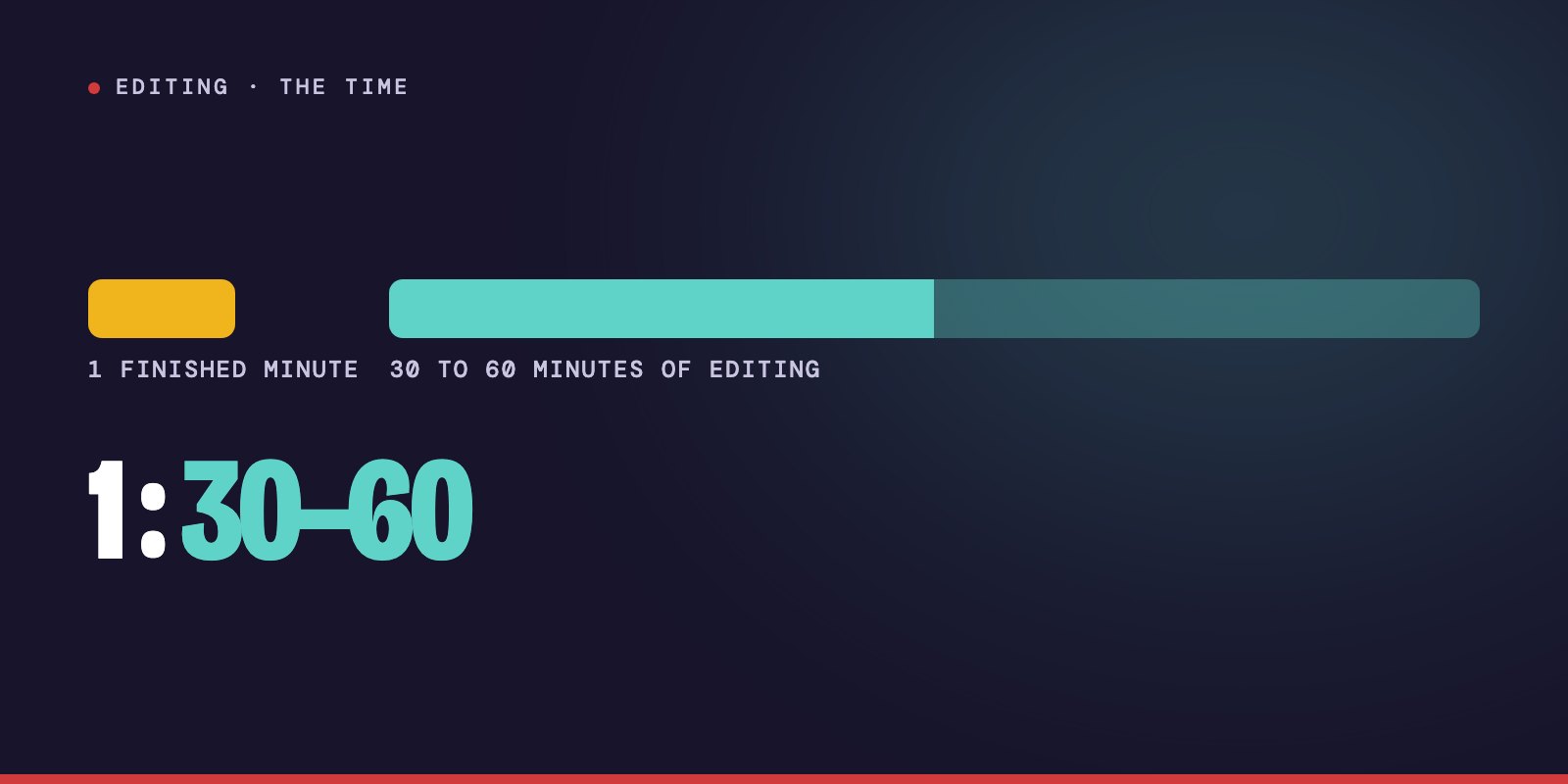
The usual rule is 30 to 60 minutes of editing for every finished minute, so a 10 minute video takes 5 to 10 hours. The rule breaks often. What decides the time is how much raw footage you recorded and how many graphics the video needs, not how long the final video is.
Ask an editor how long a video will take, and a careful one answers with a question: how much did you record?
A twelve minute video cut from fifteen minutes of footage and a twelve minute video cut from three hours share a name and almost nothing else. So let me give you the rule everybody quotes, and then tell you where it stops working.
How long does it take to edit a 10 minute YouTube video?
The rule you will find in most guides, this one for example, is 30 to 60 minutes of editing for each finished minute. By that rule, a 10 minute video takes between 5 and 10 hours.
The same guide gives two worked examples: a 5 minute video takes about 3 to 5 hours of pure editing, and a 20 minute video about 10 to 20. It adds that the time "depends heavily on the experience and skill of the editor," and that getting to a professional level takes at least six months of continuous work.
What the rule cannot tell you is the style, and other guides show how far it stretches. The production company Beverly Boy works from two hours of editing for each finished minute, and up to ten hours per minute when a video was shot in several locations. Put the two guides together and a 10 minute video can take anywhere from 5 hours to 20 or more. This is the order I would expect, from fastest to slowest:
- A simple talking head is the fastest.
- A video with B-roll, music and some graphics comes next.
- A video with heavy animation is the slowest, because every graphic is its own small project.
How long does it take to edit a 30 minute YouTube video?
By the rule, 15 to 30 hours. In practice a long interview is often faster per minute than a short video, because once the conversation is clean it holds for long stretches without needing a new decision every two seconds.
The rule also fails in the other direction. An hour-long interview does not need sixty times the work of one minute, and a ten minute video with the same density of graphics does not take a sixth of the hour-long one, because the opening, the structure and the export cost the same whether the video is ten minutes or sixty.
Why the rule breaks: the raw footage
The rule counts finished minutes. The clock counts recorded minutes.
If you recorded fifteen minutes to get ten, I watch fifteen minutes. If you recorded three hours to get ten, I watch three hours, and then I have to choose, which is slower than watching. A short video cut from a lot of footage is one of the longest jobs there is.
So when you plan your week, measure what you recorded.
Where the hours actually go
When people imagine editing, they imagine cutting. Cutting is the fast part. Here is how a typical interview divides for me, in the order I do it.
Cleaning the dialogue. Silences, filler words, repeated takes, the part where the guest's dog barked. This used to be hours. With transcript-based tools it is now the shortest step.
Structure. Deciding the chapters, where each one opens, what gets a title card. This is thinking time, and it does not look like work from the outside.
Graphics. Every number that needs a chart, every news story that needs its headline, every place that needs a map. This is the largest block by far. If your video has none, your edit is short. If it has forty, most of the time is here.
The hook. The first thirty seconds get more time per second than anything else in the video, because they decide whether the rest is watched at all. I build them last.
Review and export. Watching the whole thing at normal speed, as a viewer, and fixing what I notice. Then waiting for the export, then watching the export. Nobody budgets for this, and skipping it is how mistakes get published.
How long does it take with AI?
I use AI every day, and I would like to give you one clean number. Nobody has measured it well for video editing yet, so here is what exists.
There are surveys, where people estimate their own savings. Adobe and the research firm Advanis asked more than 400 creative professionals in March 2026, and the average answer was 17 hours saved a week. The editing platform VIDIO asked 241 of its users in early 2026: 41.5% said less than one hour a week, and only 11.6% said more than five.
The controlled experiments come from other kinds of work, and they point in both directions. I go through them in what works with Claude and Premiere.
What I can say from the chair is where the saving is: in the short, defined steps. The AI reads the transcript, finds every repeated line and builds the sequence inside the editing program.
And yet one step got longer: checking. A model can put a figure on screen that nobody in the interview said, and it will look finished. Every number has to be compared with the transcript before anything ships.
So AI moved the time. It took hours out of the building and put some of them into the reviewing. An editor who tells you AI made editing instant has stopped reviewing.
How long does it take to edit a short?
In my own work, a vertical short of thirty to sixty seconds takes between twenty minutes and two hours. I have not found a published figure I trust for this, so take it as one editor's experience.
Twenty minutes if the moment is already clear and you only need to reframe it and add captions. Two hours if you have to find the moment first, rebuild the graphics for a vertical frame and write a hook that works without the context of the full video. Finding the moment is the slow part. Once you know which forty seconds, the rest is craft. I explain how I choose them in how to make Shorts from a long video.
What a realistic week looks like
Editing time also depends on what else has to come out of the recording. If the same episode must become clips, shorts, carousels and articles, the order decides the week. The full episode comes first and everything else is cut from it, so nobody watches the raw footage twice, and the graphics are built once and reused. I lay out that plan in how to repurpose podcast content.
How to make editing faster without making it worse
Most advice about speed is about shortcuts on the keyboard. That saves minutes. These save days:
- Record less. Every minute you record is a minute somebody has to watch. Decide the outline before you press record.
- Mark the good moments while you record. Clap, say "good one," write the time on paper. An editor who knows where the gold is works twice as fast.
- Give one round of notes, complete. Five small messages across three days cost more than one long message on day one.
- Keep the same editor. The second video is faster than the first, and the fiftieth is faster than the second. Style, fonts, music, what you like and what you hate: all of that is already decided.
How long should you wait for the first version?
If you are hiring an editor, ask this before anything else, and ask what the first version includes.
A first version with clean dialogue and structure but no graphics can come back in a day, and it is the right moment to give notes, because changing the structure later means rebuilding the graphics on top of it. A first version with everything in place takes longer and should need fewer changes. Both are fine. What costs time is discovering in the last round that the order of the chapters was wrong.
So, how long does it take?
For a 10 minute video, the published rules give you between 5 and 20 hours: one to three working days, depending on the graphics. For a short, I plan about an hour, and that figure is my own.
Then ask the question that actually sets the number: how much did you record, and how much of it has to be shown and not only said?
The video's length tells you how long it takes to watch. The footage and the graphics tell you how long it takes to make.