Blog · Storytelling
Storytelling in video editing: four rules I work by
By Tomás Castaño · November 10, 2026 · 7 min read
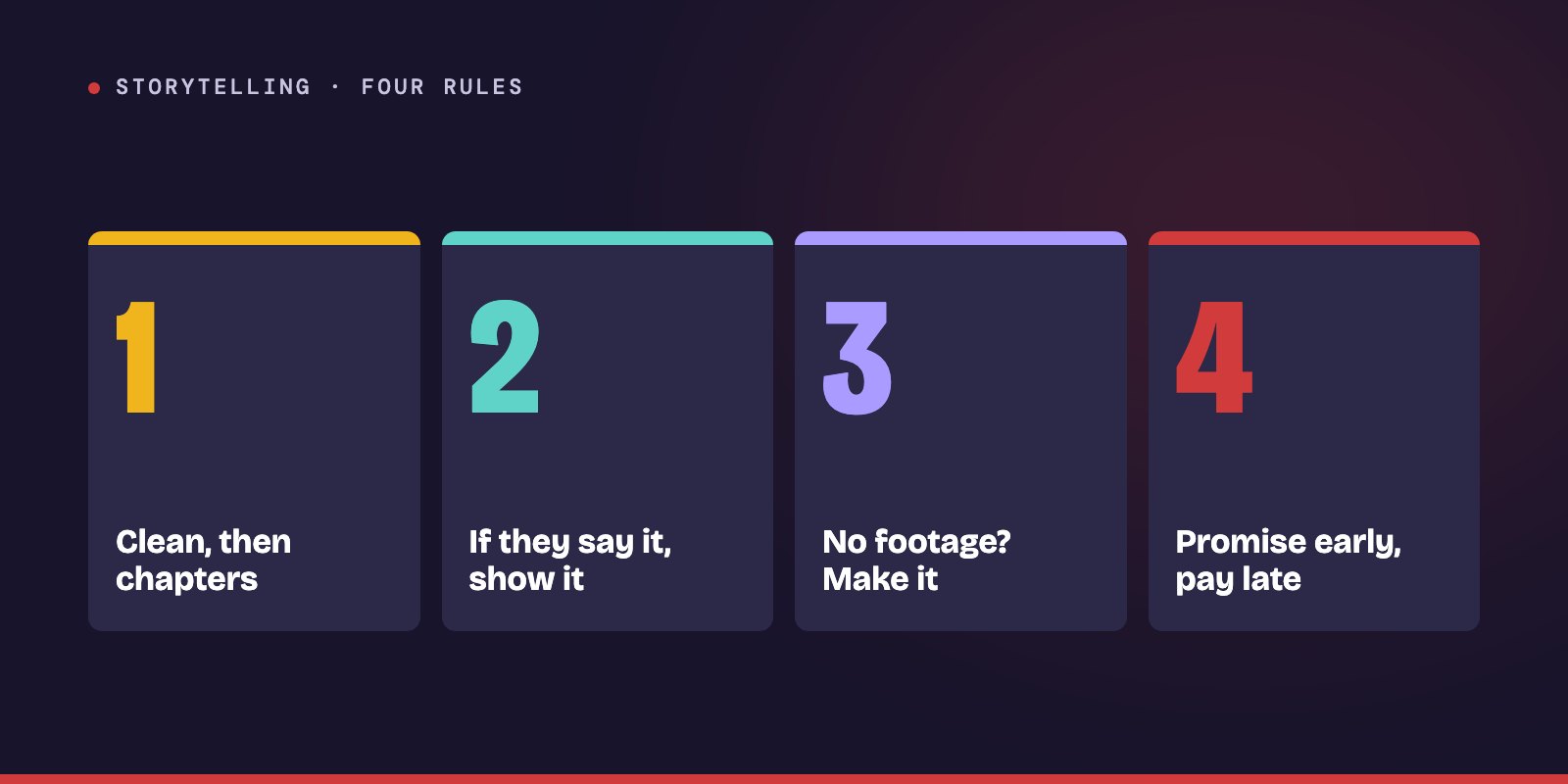
Storytelling in video editing is deciding the order in which the viewer learns things. It comes down to four rules: clean the conversation and give it chapters, show whatever is being said, make the image when no footage exists, and open with a promise that the video pays later.
A vlogger told his camera about the day his basement flooded. Water was gushing out of a pipe, he ran down the stairs, he threw towels at it. It was a good story, and he told it well.
There was no footage of any of it. Nobody films their basement while it floods. So what I had was a man in a chair, describing something the viewer would have to imagine.
Every editor meets this problem, in one form or another. How you solve it is what people mean when they say storytelling.
What is storytelling in video editing?
It is deciding what the viewer learns, and when.
The same recording can become a dozen different videos depending on the order. Start with the outcome and the video is about how it happened. Start with the question and the video is a search for the answer. Hold back one fact and everything before it becomes suspense.
A writer does this with sentences. An editor does it with material that already exists, which is harder in one way and easier in another: I cannot invent what was not said, but I can choose what comes first.
Over the years my way of doing it settled into four rules. I apply them in this order.
What the great editors say comes first
I did not invent this way of thinking. The clearest version of it comes from Walter Murch, who edited Apocalypse Now and The English Patient.
In his book In the Blink of an Eye he lists six things a good cut should respect, and he gives each a weight. Emotion is 51%. Story is 23%. Rhythm is 10%. The three technical ones, where the eye is looking and how the space holds together, share the remaining 16%. His advice is that when you cannot have everything, you give up from the bottom of the list. You never sacrifice emotion to save continuity. You can read a summary of his six rules here.
I find that list useful every week, because it settles arguments. A cut that is technically clean and emotionally dead is a bad cut.
There is an older experiment underneath it, the one with an actor's blank face and a bowl of soup. I tell it in what a video editor does.
Rule one: clean first, then give it chapters
A story cannot be told through noise. So before any storytelling, I remove what gets in the way: the silences, the filler words, the false starts, the sentence said twice.
That is not polishing. It is finding the conversation inside the recording.
Then I give it a structure. Every chapter opens with a title card and a change of music. The title tells the viewer what question this part will answer. The music tells them something new has begun.
It is the oldest device there is. A book has chapters for the same reason: the reader needs to feel they are getting somewhere. An hour without chapters is a corridor with no doors.
Rule two: if they say it, show it
I spent six years cutting interviews about the economy. Debt, interest rates, central banks. Subjects where a sentence can be perfectly true and still slide past the listener.
What I learned there became the center of how I edit. When a guest mentions a news story, the headline appears. When he gives a number, the chart draws itself. When he names a country, the map moves there. When he explains an idea, a short animation explains it with him.
The reason is simple. People follow a hard idea when they can see it. An image gives the mind something to hold while the voice keeps going.
And there is a discipline hidden in the rule: the image must say exactly what the voice says. If the chart shows a figure the guest did not say, I have not illustrated the story. I have changed it.
Rule three: no footage? Make the image
Back to the flooded basement.
It was a vlog, and a vlog can be fun, so the story became a comic. Panel by panel: the pipe, the water, the stairs, the towels. The comic became the footage, and what had been a man in a chair turned into the most alive part of the video.
For another creator, an educator, a comic would have been wrong for her. We agreed on something quieter: a character drawn in a few plain lines, who appears whenever she tells a story from her own life and acts it out.
For a sales video about a live event, I wrote a storyboard of 45 shots and generated the scenes from it, because the story it told, a family and a house and what a single income used to buy, had never been filmed by anyone.
Three stories, three techniques. The technique should fit the person telling it. What does not change is the principle: when the story exists and the pictures do not, the editor builds them.
Rule four: promise it early, pay it late
Only when the whole video exists do I go back to the beginning.
An hour-long interview has peaks, moments where something is revealed or admitted. I take one from the second half and place twenty or thirty seconds of it at the very start. The opening makes a promise, and the video keeps it late. The full method is in how to make a good YouTube hook.
That is the structure of most stories people enjoy. You are told early that something is coming, and the pleasure is in the waiting.
Why promising early works
Suspense is information given early. A viewer who knows something is coming watches differently from one who does not.
Storytellers have known it for a long time. Two thousand years ago the Roman poet Horace, in his Ars Poetica, praised Homer for carrying the listener straight into the middle of things, in medias res, with the war already under way. A hook taken from the second half of an interview is the same move: the viewer is shown where this is going before being asked to travel there.
How pacing tells the story
Pacing is how long each thing stays on screen, and it is the part of storytelling you feel without seeing.
I do not set it with a timer. I let the meaning set the rhythm. Quick cuts when the speaker is listing or arguing. A long, still shot when he is explaining something step by step. Silence, sometimes, after a line that needs a second to arrive.
A video where everything is fast has no pace at all. Pace is the difference between the fast parts and the slow ones.
What documentaries and books taught me about editing
Before YouTube I led a documentary. Two years, a volunteer crew of fifteen, and a film that ended up 48 minutes long. Two years of work, and less than an hour on screen.
That is the first lesson of any long project: the story is what remains after you remove what you loved and did not need.
I have also edited a book, and the work is strangely similar. In a manuscript you look for the sentence that carries the idea, and you cut what delays it. In a video the sentence is a moment, and what delays it is everything before the speaker gets to the point.
How to practice storytelling as an editor
If you want to get better at this, here is what helped me most.
- Read the transcript before you cut. On paper you see the structure of a conversation. On the timeline you only see the next ten seconds.
- Write the video in one sentence. If you cannot say what it is about, you cannot decide what stays.
- Find the peak first. Know where the video is going before you choose where it starts.
- Watch it without sound. If the images alone tell you something, the storytelling is working.
- Then listen without picture. If the voice alone holds you, the cleaning was good.
- Remove your favorite part and watch again. Sometimes the video gets better, and that is how you learn what it was really about.
What storytelling is not
It is not effects. A transition is not a story. Neither is a color grade, or a piece of music, or a font.
Those are the voice the story is told in, and they matter. But a video can be beautiful and say nothing, and it can be plain and impossible to stop watching.
When a client says "make it more engaging," they almost never need more movement. They need the viewer to want to know what happens next.
The effects are how a video looks. The story is why someone stays.